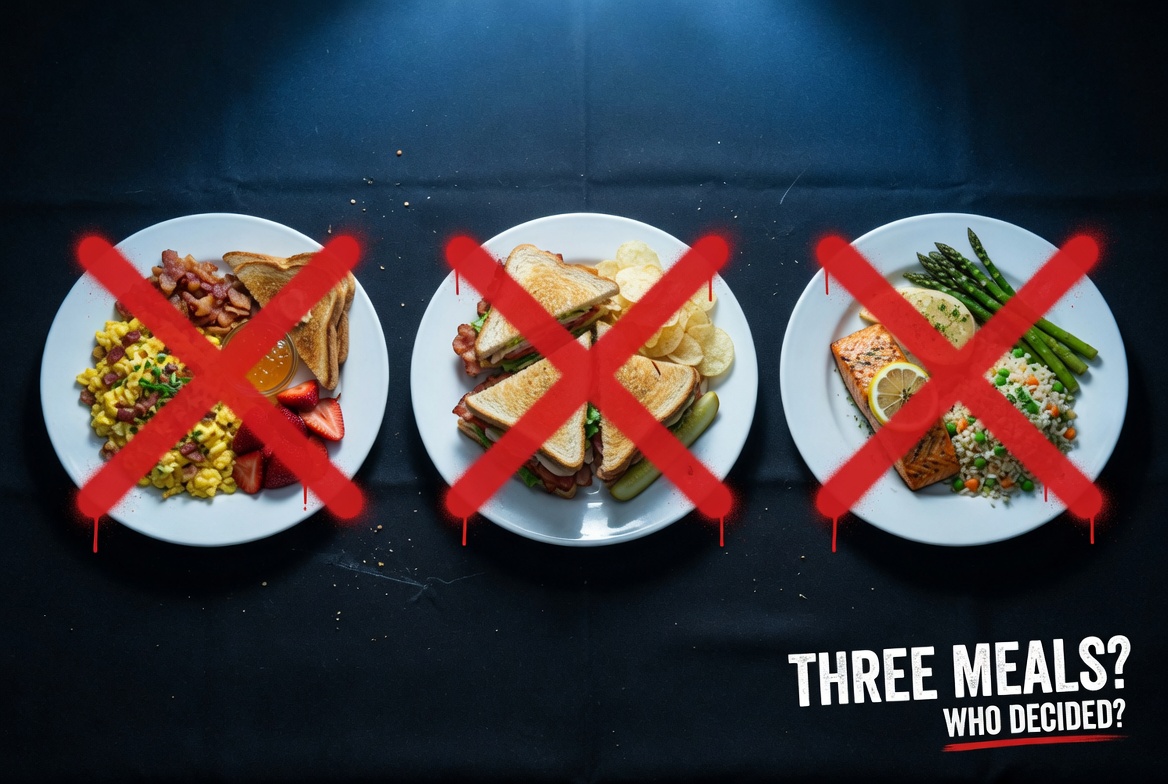
Breaking the 3-Meal-a-Day Myth
Breakfast, lunch, dinner, and snacks. That's 4–6 eating opportunities per day — each one a chance to overeat. There's a simpler way.
💡 Historical Reality Check
Three meals a day is a relatively recent cultural invention — not a biological requirement. For most of human history, people ate when food was available, which was often once or twice a day. The "three meals plus snacks" pattern was popularized by industrial work schedules and aggressively reinforced by the food industry because more meals = more food sold.
Why 3 Meals Creates Overeating

- More meals = more decision points. Every meal is a chance to make a bad choice. Reduce the number of meals, reduce the number of opportunities to overeat. Simple math.
- Snacking is often the hidden culprit. "Just a handful" of almonds is 170 calories. A granola bar is 200. A latte is 250. Add two snacks to three meals and you've added 400–600 calories that are easy to overlook.
- "Breakfast is the most important meal" is marketing. This phrase was literally created by the cereal industry. You do not need to eat immediately upon waking. Your body has plenty of stored energy. Skip it, or move it later — most people find they're not genuinely hungry until 10am or later.
- Constant eating prevents fat burning. Every time you eat, your insulin rises and fat burning stops. If you're eating every 3 hours, your body never gets the chance to access stored fat. You're running on a constant drip of dietary calories instead.
3 Meals + Snacks vs. 2 Meals — Calorie Impact
Typical 3-Meals + Snacks Pattern
2-Meal Pattern (No Snacks)
950 fewer calories per day — that's nearly 2 lbs of fat loss per week, just from meal structure.

The Breakfast Industry Lie
"Breakfast is the most important meal of the day" was coined by Grape-Nuts cereal in 1917 as part of an advertising campaign. It was never based on nutrition science — it was based on selling cereal. The studies frequently cited to support breakfast are observational and riddled with confounders.
Randomized controlled trials tell a different story: skipping breakfast does not slow your metabolism, does not cause muscle loss, and does not impair cognitive function in adults. What it does do is eliminate 300-500 calories from your daily intake — effortlessly.
What to Do Instead
Experiment with 2 meals per day — no snacks. Most people thrive on a lunch and dinner pattern, with nothing but water, black coffee, or plain tea between meals. This naturally creates a 14–16 hour fasting window overnight.
You'll notice something remarkable after a few days: you're not actually hungrier. Your body adjusts. The "need" to eat breakfast fades. The afternoon snack craving disappears. You start eating only when your body genuinely needs fuel — and you naturally eat less total food.
🎯 The 1-Week Challenge
For one week, skip breakfast entirely. Have your first meal at noon. No snacking between noon and dinner. Just do it for 7 days and track how you feel. Most people report increased energy, improved focus, and zero actual hunger — once they push past day 2-3 of adjustment.
Tools That Help
Mealcon 16-Piece Glass Set
8 glass containers and 8 lids. Prep two meals ahead. A 28-piece set is a different listing.
View product →The Obesity Code by Jason Fung
Dr. Fung's deep dive into why meal frequency matters, how insulin drives fat storage, and why eating less often is the simplest intervention.
Shop on Amazon →Black Coffee Equipment
A great cup of black coffee makes the morning fast easy. Pour-over makes excellent coffee that doesn't need milk or sugar.
Shop on Amazon →Herbal Tea Variety Pack
Zero-calorie, zero-caffeine, and surprisingly satisfying. A warm cup of herbal tea kills evening cravings without breaking your fast.
Shop on Amazon →As an Amazon Associate, I earn from qualifying purchases. Product links on this page are affiliate links — they cost you nothing extra.