CICO Science
Calories In vs. Calories Out isn't a diet — it's the first law of thermodynamics applied to your body. Here's the evidence.
The Science of CICO

Every diet that has ever worked — keto, vegan, paleo, Mediterranean, carnivore, Atkins, Weight Watchers — works because it creates a caloric deficit. The mechanism varies but the principle is universal:
This doesn't mean all calories are equal in terms of nutrition, satiety, or hormonal response. It means they are equal in terms of energy. 500 calories of broccoli and 500 calories of candy provide the same energy — but wildly different fullness, nutrition, and metabolic effects.
Energy Balance — The Only Law That Matters
Common Objections — Answered

Internet diet culture loves to tell you CICO is "outdated" or "oversimplified." Here are the five most common objections — and why they're wrong:
"Not all calories are created equal"
True — but irrelevant to energy balance.
This is a nutrition argument, not a thermodynamics argument. Yes, 200 calories of chicken breast is more satiating and nutrient-dense than 200 calories of gummy bears. That's why food quality matters for adherence.
But in controlled metabolic ward studies — where participants eat identical calories from different macronutrient compositions — weight change is virtually identical:
- Sacks et al. (2009) — 811 participants, 4 different macro compositions, 2 years. All groups lost the same amount of weight.
- Bray & Popkin (1998) — Meta-analysis confirming isocaloric diets produce equivalent weight loss regardless of fat/carb ratio.
Food quality determines how easy it is to maintain a deficit. Energy balance determines whether you lose weight.
"Hormones control weight, not calories"
Hormones influence appetite, partitioning, and metabolic rate — but they can't override thermodynamics.
Insulin, leptin, ghrelin, cortisol — all real hormones with real effects on hunger, fat storage preference, and energy expenditure. But they operate within the energy balance framework, not outside it:
- Insulin doesn't make you fat — chronic caloric surplus makes you fat. Insulin goes up after you eat because that's its job: shuttling nutrients into cells.
- People with type 1 diabetes (zero insulin production) waste away despite eating, because without insulin, cells can't absorb glucose. This actually proves insulin is required for energy storage — not that insulin causes obesity.
- Thyroid hormones affect BMR by 10-15%, which changes the "Calories Out" side — but doesn't break CICO.
Hormones modulate the variables in the energy balance equation. They don't invalidate the equation.
"My metabolism is broken/slow"
Metabolic variation between individuals is real but small.
Studies measuring BMR across thousands of people show that 96% fall within ±200 calories of the predicted value for their age, sex, height, and weight:
- Donahoo et al. (2004) — Comprehensive review of BMR variation, confirming tight clustering around predicted values.
- The "slow metabolism" someone reports is usually a combination of: lower NEAT (non-exercise activity thermogenesis), overestimating exercise calories, and underestimating food intake.
- Metabolic adaptation to dieting is real — your body reduces BMR by 5-15% during extended deficits — but this is accounted for by adjusting calories downward, not by abandoning CICO.
If you're not losing weight, the most likely explanation is that you're not yet in a true deficit. The fix is usually better tracking — not a different theory.
"Counting calories doesn't work long-term"
Adherence failure isn't evidence against the mechanism.
This is like saying "budgeting doesn't work" because most people fail to stick to budgets. The math works perfectly — the challenge is behavioral:
- Long-term weight loss maintenance (5+ years) is achieved by ~20% of dieters — and the ones who succeed almost universally report continued awareness of energy intake.
- The National Weight Control Registry (10,000+ participants who lost 30+ lbs and kept it off for 1+ year) shows common traits: regular physical activity, consistent eating patterns, and self-monitoring.
- You don't need to track forever — but you need to understand the caloric density of what you eat. Most people who learn to track for 3-6 months develop intuitive portion awareness.
CICO works when adhered to. The solution is better strategies for adherence (like intermittent fasting, high-protein diets, volume eating) — not abandoning the framework.
"You can't accurately count calories anyway"
Imprecise measurement doesn't invalidate the principle.
Yes, calorie counts on food labels can be off by 10-20%. Yes, your TDEE estimate is an approximation. But:
- The errors are consistent — if a food is always labeled 10% low, your tracking still captures the trend.
- The goal isn't perfection — it's a reasonable estimate that you adjust based on real-world results. Weigh yourself weekly and adjust intake accordingly.
- Using a food scale dramatically improves accuracy. Most people who "can't lose weight counting calories" are estimating portions by eye — which studies show is off by 40-100%.
You don't need perfect data. You need consistent data and a willingness to adjust. Track imperfectly, weigh regularly, and iterate.
The Bottom Line
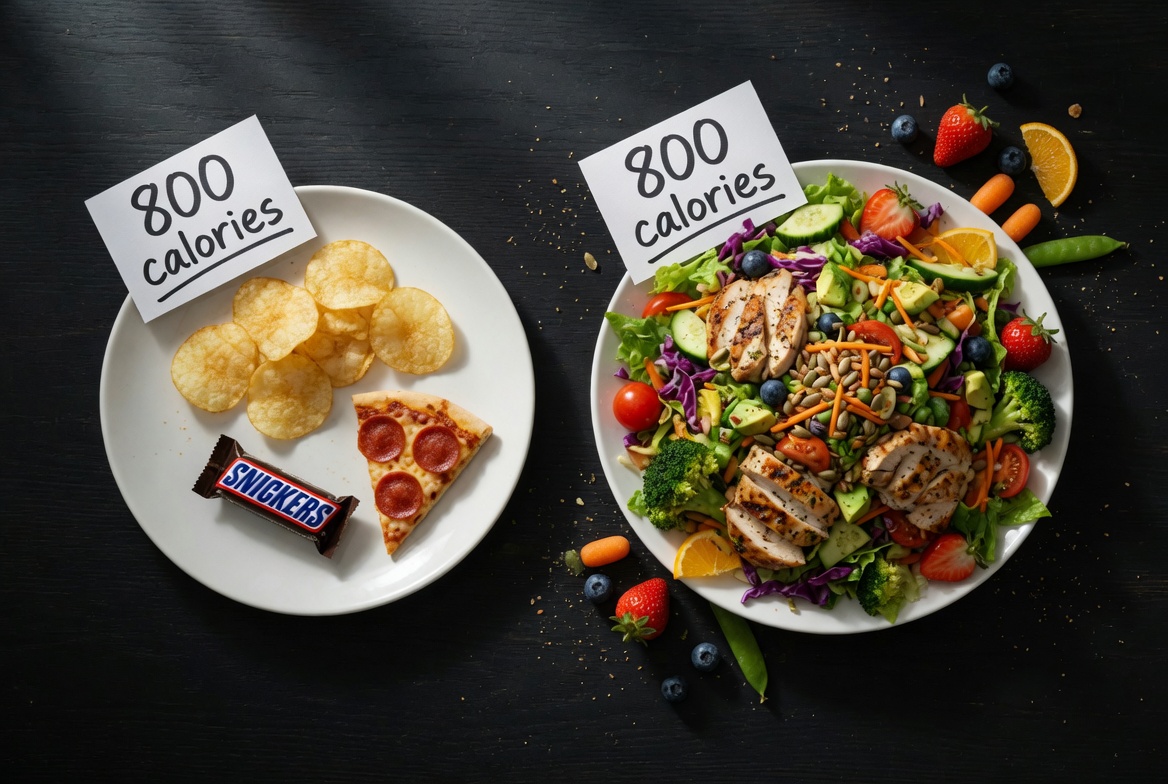
CICO is not a diet. It's the physics of your body. Every successful diet leverages it — whether explicitly (calorie counting) or implicitly (eating patterns that naturally reduce intake).
The strategies we recommend on this site — intermittent fasting, high-protein eating, volume foods — all work because they make it easier to maintain a caloric deficit without feeling miserable. They don't circumvent CICO; they make CICO sustainable.
Start Tracking
Greater Goods 22 lb Food Scale
22 lb capacity, 1 g steps, grams. Stop guessing portions.
View product →Calorie Counting Guide
Learn to estimate calories intuitively. Most people only need 3-6 months of active tracking to develop the skill.
Shop on Amazon →Portion Control Plates
Visual portion control without counting. Great for people who want partial awareness without full tracking.
Shop on Amazon →Body Weight Scale
Weigh daily, track the weekly average. The trend line is what matters — not any single day's number.
Shop on Amazon →As an Amazon Associate, I earn from qualifying purchases. Product links on this page are affiliate links — they cost you nothing extra.